Songs of the Far West: where the cowboy soundtrack actually came from
The 'western' sound in your head — that whistle, that twang, that gunfighter ballad — is a hybrid invention. Half of it was sung on cattle trails in the 1870s; half was recorded in a Rome studio in 1966. The two halves never met. A field guide to how a real frontier and an Italian film score fused into a single genre.
By Gabin Fay
There is a sound most people in the world can identify in under two seconds: a single whistled melody, a twangy reverb-soaked electric guitar, a male choir hum, the snap of a whip. Ask any listener born after 1970 what it represents and they will say cowboys, desert, gunfight at noon. Ask them where it comes from and most will guess John Wayne, the American West, Texas, the open prairie.
Almost none of that is correct. That sound was recorded in Rome in 1966, by an Italian composer who had never been to the American West, for a film directed by another Italian who had also never been there, scored against location footage shot in Almería, Spain. The "western" of the popular ear is a Mediterranean invention dressed in American iconography. The actual American frontier had its own music — sung on cattle drives, in trail camps, on horseback, between 1865 and 1890 — and it sounded almost nothing like what we now call western.
The genre we hear is a fusion of two separate traditions that never knew each other:
- the trail tradition — work songs and ballads sung by cowboys on the long drives between Texas and Kansas, derived from English, Scottish, Irish and African-American folk material, transcribed by a Texas folklorist in 1908 and almost forgotten by 1930;
- the studio tradition — songs written about cowboys by Hollywood and Nashville composers between 1934 and 1970, designed to soundtrack films, sell records, and create the idea of "the cowboy song" as a marketable genre.
The first tradition is older. The second is the one that won.
→ The Songs of the Far West — the 30-track Spotify playlist (generated by Playgen)
I. The trail (1866–1886)
The post-Civil War cattle drive lasted about twenty years. Between roughly 1866 and 1886, somewhere between five and ten million longhorns were driven from Texas to railheads in Kansas — to Abilene, then to Dodge City, then to Ogallala in Nebraska — by crews of ten to twenty mounted cowboys. The work was monotonous, dangerous, and conducted across distances of 800 to 1,500 miles. The drives lasted two to four months. The cowboys, around a third of whom were African-American and a quarter of whom were Mexican (the vaqueros whose techniques, vocabulary, and equipment the entire profession had inherited), spent the evenings around a campfire and the nights two at a time on guard duty, circling the bedded herd.
The night herders sang. This is the documented origin of cowboy music: it was a tool. A herd of two thousand longhorns can stampede on a thunderclap or a coyote yip; a low continuous human voice familiarised the animals with sound and reduced the probability of a startle. The night-songs were quiet, sustained, in a comfortable male range, with simple repetitive melodies — exactly what works when you are trying to soothe several hundred tons of nervous beef.
The melodic material came from what the cowboys had grown up with. Scottish, Irish and English ballads carried west by emigrants. African-American work songs and field hollers, which several of the Black cowboys could draw on. Mexican corrido narrative ballads and canción ranchera. Sailor's chanteys repurposed for prairie use — the structure of Goodbye Old Paint, a song addressed to a horse before parting, mirrors the form of a sea farewell almost exactly. The drovers borrowed melodies promiscuously, attached new words about herds and horses and dead trail companions, and the same song would surface in five different versions a hundred miles apart.
The Old Chisholm Trail is the canonical example. The song has no fixed lyrics — it is a frame for improvisation, four-bar verses about whatever happened that week on the trail, attached to a melody that almost anyone could pick up in one sitting. Some collected versions run to 143 verses. The trail it describes ran from south Texas to Abilene, Kansas; it was active roughly 1867–1884, and named after Jesse Chisholm, a Cherokee-Scottish trader who had cut part of the route delivering freight in 1864–65. The song is older than most of the cowboys who sang it and survived the trail's closure by a century.
Bury Me Not on the Lone Prairie is the dying-cowboy ballad. Its melody and structure are an exact recasting of a maritime ballad, "The Ocean Burial" ("O bury me not in the deep, deep sea"), published as sheet music in 1850 with words by Reverend Edwin Hubbell Chapin. The cowboys reset it on the plains within twenty years. The transposition is total: the same melodic curve, the same self-pitying first-person address, the same theatrical request to be carried home — only the ocean has become a prairie. The version recorded much later by William Elliott Whitmore preserves the original frame.
Streets of Laredo — the "Cowboy's Lament" — is another import. Its parent ballad is "The Unfortunate Rake," an 18th-century English-Irish broadside about a young soldier dying of syphilis ("I see by your dress that you are a cowboy" replacing "I see by your dress that you are a rake"). The cowboy version moves the funeral procession to Laredo, Texas, but the formal structure — the dying man, the bystander narrator, the slow march tempo — is unchanged. The same template later generated the New Orleans variant "St. James Infirmary" and a half-dozen other death ballads. Cowboy music's relationship to its sources is closer to translation than composition.
Red River Valley drifted south from Manitoba. Folklorist Edith Fowke traced it to the Red River that flows north from Minnesota into Canada and identified versions sung in southern Manitoba in the 1870s, attached to the departure of British and Canadian soldiers and Métis settlers. The lyric ("From this valley they say you are going") was reset for any goodbye context. By the 1890s it was a cowboy song in Texas. By the 1930s it was a Hollywood standard.
Home on the Range is the one cowboy song with a documented author. Brewster M. Higley, a Kansas homesteader and physician, wrote the poem "My Western Home" in 1872, sitting in a dugout cabin in Smith County in north-central Kansas. His friend Daniel E. Kelley set it to music. The song circulated orally for sixty years before becoming Franklin Roosevelt's favourite song, the unofficial anthem of the American West, and the official state song of Kansas (1947). The cowboys passed it around without knowing whose it was. They almost never did.
II. John Lomax and the rescue (1907–1910)
By 1900 the cattle drives were over. Barbed wire (patented 1874) had closed the open range over the 1880s; the Texas-Kansas trails were broken by fenced ranches and rail extensions; the working life that had produced the trail songs had ended within a single generation. The songs survived only orally, in the memories of men who were by then in their fifties and sixties.
John Avery Lomax noticed. Lomax — born 1867 in Mississippi, raised on a small farm near Meridian, Texas, on the Chisholm Trail itself, where he had heard cowboy songs as a child — went to Harvard in 1906 to study English. His professor George Lyman Kittredge, the great American Anglo-Saxonist, told him the cowboy songs were probably more interesting than the Anglo-Saxon ballads and gave him a small Harvard travelling fellowship to collect them. Lomax spent the summers of 1907, 1908 and 1909 driving an Edison wax-cylinder phonograph through Texas, Oklahoma, New Mexico, Arizona, Wyoming and Montana, recording aging cowboys, ranchers and former trail bosses singing what they could still remember.
He published the result in November 1910 as Cowboy Songs and Other Frontier Ballads, the foundational document of the genre. It contained 112 songs with melodies and lyrics — including "Home on the Range" (which the book pulled from regional obscurity into national consciousness), "The Old Chisholm Trail," "Bury Me Not on the Lone Prairie," "Streets of Laredo," "Goodbye Old Paint," and dozens of others. President Theodore Roosevelt wrote the preface. The book sold modestly at first, then continuously for decades. It is essentially the only reason the trail tradition is recoverable at all.
Lomax did the same work later, with his son Alan, for African-American work songs in the Mississippi Delta — the recordings that produced Leadbelly, Muddy Waters at Stovall, and the Lomax-archive blues — and the methodology was the same: get to the witnesses before they died, with whatever recording technology fits in a Model T. The cowboy-song work came first, and it provided the template.
The crucial point is that everything we know about pre-1900 cowboy music depends on Lomax's intervention. The recording industry did not exist when the trails were active. By the time it did, the cowboys could not be found. A 23-year-old Harvard graduate student carrying a phonograph through the southwest in 1908 is the entire archive. Almost every trail song still in circulation in 2026 passed through his manuscript.
III. The singing cowboys (1934–1953)
In the early 1930s, Republic Pictures — a low-budget Hollywood studio founded by Herbert Yates in 1935, specialising in B-movie westerns shot on the same Vasquez Rocks set north of Los Angeles — discovered that audiences would pay to see cowboys sing on screen. The first singing cowboy was Ken Maynard, briefly, in 1929. The transformation into a genre came with Gene Autry, an Oklahoma-born radio singer and former railroad telegrapher who had been recording country songs for the American Record Corporation. Autry signed with Republic in 1934, starred in The Singing Cowboy (1936), and within five years was a fixture of American childhood: Saturday matinee features, a radio show (Melody Ranch, CBS, 1940–1956), a recording career, comic books, branded merchandise, eventually his own ranch and television production company.
The "singing cowboy" film was a hybrid genre. The plot was a low-stakes western — rustlers, mortgages, a corrupt cattle buyer, a clean fistfight, a clean shootout, a chaste romance — with three or four musical numbers inserted as standalone showcases. The songs were not the trail songs Lomax had collected. They were written about cowboys, by Tin Pan Alley professionals, in a deliberately sentimentalised register: vast skies, lonely riders, true love, faithful horses, the bunkhouse fireside. The music was Tin Pan Alley orchestration with a cowboy lyric on top. The trail songs were too slow, too repetitive, and often too grim for the form.
Tumbling Tumbleweeds, written by Bob Nolan in 1932 and performed by his vocal group Sons of the Pioneers (formed 1933 in Los Angeles with Roy Rogers as a founding member), is the template. Three-part close harmony, romantic imagery of drifting through the desert, an instantly memorable melody — and no resemblance to any pre-1900 cowboy song. Nolan was Canadian, born in New Brunswick. He had never worked cattle. Sons of the Pioneers became the most prolific source of the singing-cowboy songbook: Cool Water (1936), also Nolan's, became one of the genre's standards.
Back in the Saddle Again was Gene Autry's signature, adopted as the theme to Melody Ranch and recorded multiple times across his career. It was co-written by Autry with Ray Whitley, a singer-songwriter from Georgia who had improvised the title phrase in a 1938 morning conversation with his wife about going back to work at the studio.
Don't Fence Me In was written by Cole Porter in 1934. Cole Porter — Yale graduate, Indiana-born sophisticate, author of "Night and Day," "I've Got You Under My Skin," "Let's Do It" — wrote the cowboy anthem of the late-Hollywood-western era. He had been commissioned for an unproduced film called Adios Argentina, and reworked verses from a Montana cowboy poet named Robert Fletcher. Porter never finished the rework to his satisfaction. The Warner Brothers musical Hollywood Canteen released it in 1944, with Roy Rogers (and a second version by Bing Crosby and the Andrews Sisters) and it became a #1 hit. Porter publicly disowned it as his worst song.
Happy Trails, the closing theme of The Roy Rogers Show (NBC, 1951–1957), was written by Roy Rogers's wife and co-star Dale Evans in 1950. The song was sung by the couple as the end credits rolled, in matching outfits, on horseback, looking directly into the camera. It is the most directly nostalgic artefact of the entire singing-cowboy era — a song about the cowboys riding out of view, written by people who were watching the genre end while it was still running.
The singing-cowboy film as a viable genre dissolved with the arrival of television in the early 1950s. Republic Pictures stopped producing them in 1953. Gene Autry shifted to TV. By 1955 the form was effectively over — but its songs had entered the American repertoire, and they had become what most listeners meant when they said "cowboy music." The pre-1900 trail material that Lomax had collected was, for the second time, largely displaced from the popular ear.
IV. Marty Robbins and the gunfighter ballad (September 1959)
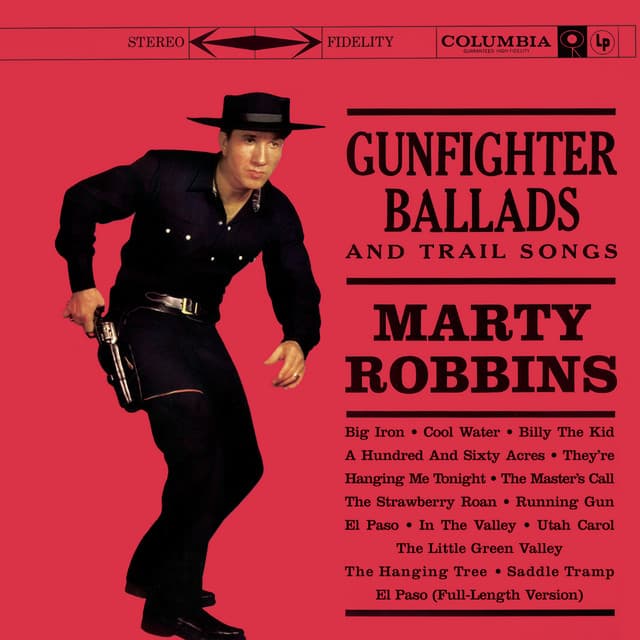
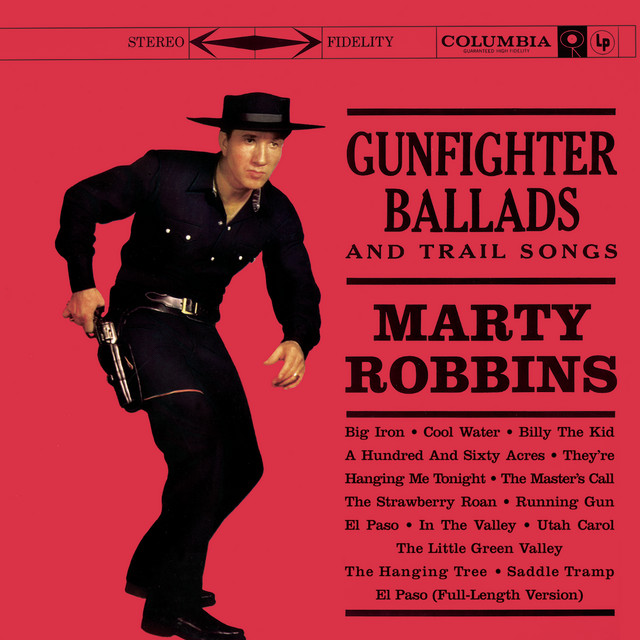
The next phase began with a single album. Gunfighter Ballads and Trail Songs by Marty Robbins was released by Columbia on September 14, 1959. Robbins — born Martin David Robinson in Glendale, Arizona, in 1925, raised partly by a half-Paiute grandfather who told him cowboy stories — had been a successful country and pop singer through the mid-1950s, with crossover hits like "Singing the Blues" and "A White Sport Coat (and a Pink Carnation)." The 1959 album was a deliberate change of direction. It was the first concept album of "western songs" written by a Nashville artist for a Nashville label, recorded in three sessions in April 1959, with classical guitar by Grady Martin and gut-string Spanish-guitar atmosphere throughout.
The album's defining track, El Paso, is a four-minute, 38-second first-person narrative ballad about a young cowboy who shoots a rival for a Mexican dancer in Rosa's Cantina, flees across the desert into New Mexico, is drawn back to her, and is killed by a posse as he reaches her arms. The song was written by Robbins on a drive from Phoenix to Texas, looking out the car window at the El Paso landscape. It hit #1 on both the country and pop charts in January 1960, won the first Grammy for Best Country & Western Recording, and ran for four and a half minutes at a time when AM radio considered three minutes the upper limit. Stations played it anyway.
The album also produced Big Iron — Arizona Ranger arrives, "Texas Red was the outlaw's name," waiting quietly to draw against a man who has killed twenty other lawmen — and The Hanging Tree and a Robbins recording of Streets of Laredo that pulled the old trail ballad back into the pop charts in adapted form. The whole record is a closed narrative world: gunfighters, frontier marshals, half-Spanish border towns, the specific moral universe of the post-Civil-War southwest. Robbins essentially invented "the gunfighter ballad" as a song form. Gunfighter Ballads and Trail Songs has never gone out of print.
Robbins's success ran in parallel with a wave of TV western themes that became chart pop in their own right. Rawhide, Frankie Laine's theme to the CBS series (1959–1965, starring a young Clint Eastwood), reached #4 in the UK and was rewritten endlessly. The instrumental Al Caiola version of the Bonanza theme charted in 1961. (Ghost) Riders in the Sky, written by Outlaws-screenwriter Stan Jones in 1948 about a vision of damned cowboys chasing a thundering ghost-herd across a black sky, became a Burl Ives hit, an Eddy Arnold hit, then a Johnny Cash interpretation that fixed it permanently in the canon. High Noon (Do Not Forsake Me, Oh My Darling), Dimitri Tiomkin's title song for the 1952 Gary Cooper film, sung by Tex Ritter over the opening credits, established the structural use of a sung ballad as the spine of a film's narrative — a method later Italian directors would adopt in extreme form.
V. The Italian invention (1964–1968)
In 1964, a 33-year-old Italian film composer named Ennio Morricone scored a low-budget Italian western called Per un pugno di dollari — A Fistful of Dollars — directed by his former primary-school classmate Sergio Leone, shot in the Tabernas Desert south of Almería, Andalusia. The film was an unauthorised remake of Akira Kurosawa's Yojimbo (1961). Its star, an unknown American TV actor named Clint Eastwood, had been hired because the original choice, Henry Fonda, had refused. Morricone had been hired because his fee was low. He had never seen an American western.
What he produced was not a film score in the conventional sense. A Fistful of Dollars — Titles opens with a whistled melody, an electric guitar phrase, a male choir, percussion built from anvil strikes and whip-cracks, a Jew's harp, and an ocarina. None of those instruments had previously appeared in an American western score. Morricone had a wider problem: the budget could not afford a full orchestra, so he replaced absent instruments with unconventional ones (the whistle is Alessandro Alessandroni, an Italian session musician who would whistle on the next three Leone films; the choir is the I Cantori Moderni vocal group, also Alessandroni's). The shortage produced the aesthetic. The sound of insufficient orchestration became the iconography of the genre.
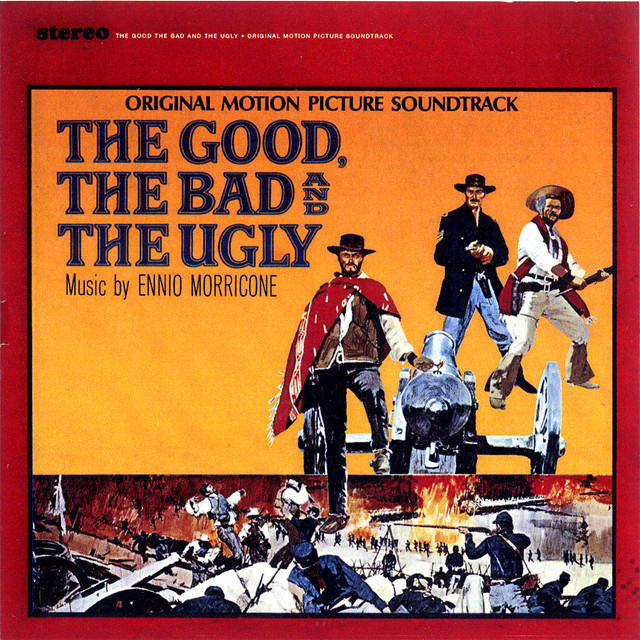
A Fistful of Dollars was a regional Italian hit in 1964, then expanded across Europe through 1965, then reached the United States only in January 1967, by which point Leone and Morricone had already finished the next two films of the trilogy. For a Few Dollars More (1965) added the musical pocket-watch — a melody played by a mechanical music-box embedded in the film's plot, which becomes the cue for the final shootout — and tripled the budget. The Good, the Bad and the Ugly (1966) is the masterpiece. Its score is a closed musical system in which the main theme (the "coyote howl" two-note motif, with different instruments standing in for the three protagonists), The Ecstasy of Gold (the cemetery sprint), and several thematic variations are bound together across a 178-minute film. The Italian release date was December 23, 1966. The American release was December 29, 1967 — over a year later.
By the time American audiences first heard The Good, the Bad and the Ugly, the score had been a chart success across Europe for twelve months. Morricone had recorded the album version — released as Il Buono, il Brutto, il Cattivo, RCA Italy, 1966 — separately from the film soundtrack, with Bruno Nicolai conducting and Edda Dell'Orso as the soprano on "The Ecstasy of Gold." Dell'Orso's vocal — wordless, soaring, riding the orchestral surge — became the genre's signature female sound. She was not credited in the original American release.
Once Upon a Time in the West (1968), Leone's fourth and final film with Morricone in the western mode, took the method to its limit. Morricone wrote the score before shooting began; Leone played the cues on set so the actors could time their performances to the music; the resulting film has dialogue scenes deliberately stretched across slow musical phrases, including the famous nine-minute opening at a railway station built around a creaking windmill and three killers waiting for the train. The film's commercial reception in 1968 was muted (Paramount cut twenty minutes from the U.S. release); its reputation grew steadily until, by the late 1980s, it was being routinely ranked among the greatest films ever made. The harmonica theme — played by Franco De Gemini — is now one of the most recognisable musical fragments in cinema.
The crucial fact is that the entire "spaghetti western" musical vocabulary was assembled in Rome. The whistled themes, the electric guitar twang, the choir, the wordless soprano, the percussion built from non-musical objects, the use of leitmotif-per-character, the integration of musical cues with cinematography — none of it had existed before 1964 in American film, and almost all of it had passed into American film by 1972. The genre's sonic identity in the popular memory is not the cowboys' music and not the singing cowboys' music. It is Morricone's music. The American West, in the ear of the world, sounds Italian.
VI. The outlaw rebrand (1973–1981)
By the early 1970s, the Nashville country industry had calcified into a tightly produced "Nashville Sound" — strings, vocal choirs, polished arrangements — and a small group of country artists started pushing against it. Waylon Jennings, a Texas-born former bass player in Buddy Holly's band, renegotiated his RCA contract in 1972 to claim creative control over his own recordings — unusual for a Nashville artist of his stature. Willie Nelson left RCA in 1972 after years of frustration and signed to Atlantic, then Columbia, on similar terms. The two of them, along with Tompall Glaser, Kris Kristofferson, Jessi Colter (Jennings's wife) and Billy Joe Shaver (the songwriter for much of Jennings's early outlaw catalogue), produced through the mid-1970s a body of work that adopted the iconography of the western — the gunfighter, the drifter, the outlaw, the long ride — and pinned it to a deliberately stripped, rough, country-rock production aesthetic.
The 1976 RCA compilation Wanted! The Outlaws — featuring Jennings, Nelson, Glaser and Colter — was the first country album to be certified platinum, and gave the movement its name. The "outlaw" framing was partly marketing (RCA capitalised on Jennings's earlier renegotiation), partly genuine (these artists were taking commercial risks and producing their own records), and partly the explicit revival of frontier myth. Several of the songs read like 1870s ballads in updated form: someone is in trouble with the law, someone is on the road, someone is past forgiveness.
Lonesome, On'ry and Mean — written by Steve Young, recorded by Jennings in 1973 — is the manifesto. Three adjectives, first-person, present tense, no narrative. The protagonist is not a literal cowboy; he is the attitude of the cowboy, transposed onto a modern country singer. The song's structural ancestor is Streets of Laredo — the same self-pitying first-person address, the same fatalism — minus the literal frontier setting.
Red Headed Stranger, Willie Nelson's 1975 concept album, is the masterpiece of the period. The album is a 33-minute narrative song-cycle about a preacher who murders his wife and her lover, flees west, kills a woman who tries to take his dead wife's horse, and is eventually granted absolution by a stranger he meets in Montana. It was recorded at Autumn Sound studios in Garland, Texas, on a budget of $20,000, with intentional sparseness — guitar, piano, harmonica, voice. Columbia was reportedly horrified by the unpolished sound; the album sold over five million copies. The song-cycle structure is essentially identical to the 19th-century ballad-cycle method (El Paso expanded into album form) and is the longest-form descendant of the trail-ballad tradition.
Mammas Don't Let Your Babies Grow Up to Be Cowboys, written by Ed Bruce and his wife Patsy in 1975, became the Jennings-Nelson duet that defined the outlaw aesthetic for a general audience. It hit #1 country in May 1978. The song's joke is not a joke: it is a direct admission that the cowboy life is a romanticised disaster and that the singer wishes he had picked another profession. The trail tradition's underlying tone — fatalism dressed in tough talk — surfaces almost unchanged a hundred years later.
Pancho and Lefty, the Townes Van Zandt song, recorded as a duet by Willie Nelson and Merle Haggard in 1983, was the late peak. It is a complete border ballad — Pancho hangs in Mexico, Lefty escapes to Cleveland — written in 1972 by Van Zandt, who claimed the song had been delivered to him "by God" in a single sitting. The Nelson-Haggard recording hit #1 country in January 1983. The Van Zandt original is the better record, but the duet is the one that reached the general public; both belong in the western canon.
VII. The revival (2015–)
By 1990 the outlaw moment had ended, and the cowboy song lost its place at the centre of country music. The 1990s and 2000s "new country" era (Garth Brooks, Shania Twain, Kenny Chesney) was suburban-romantic and stadium-scaled; the cowboy material had become an occasional novelty rather than a central tradition. The trail songs were preserved by folk and bluegrass acts — Michael Martin Murphey, who released the Cowboy Songs series starting in 1989 — but the form's commercial relevance was minor.
The 2015–2025 revival has been led by a small handful of young performers raised on Marty Robbins and Townes Van Zandt who decided to return to the form unironically. The most consistent of them is Colter Wall, a Saskatchewan-born singer who grew up on his family's cattle ranch outside Speers, started recording in his late teens, and released his first full album in 2017. Wall's voice is a baritone closer to Johnny Cash's than to any contemporary country singer's; his recording approach is deliberately minimal (guitar, voice, occasional fiddle, almost no overdubs); his subject matter is cattle work, horse training, prairie travel, ranch life on the Canadian-American border.
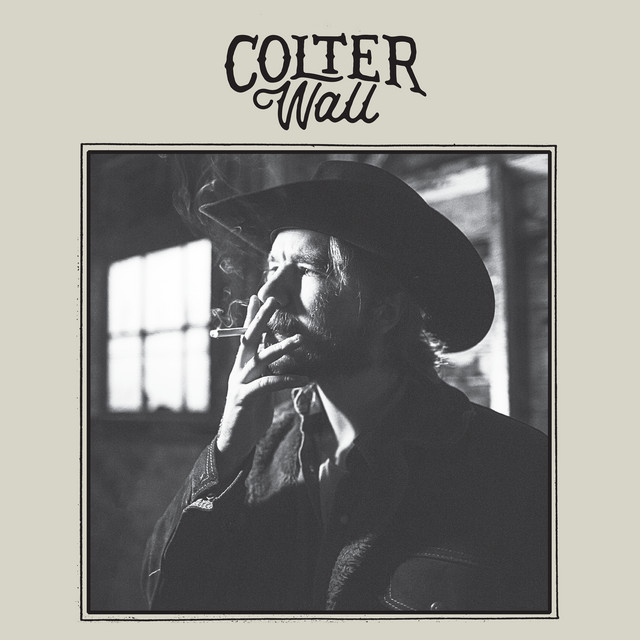
Kate McCannon is Wall's first-person murder ballad — a young man kills his unfaithful lover in a hilltop holler — and is structurally indistinguishable from a 19th-century Appalachian-frontier ballad. Cowpoke, his version of a 1948 song by Stan Jones (also the author of "Ghost Riders in the Sky"), is the trail tradition restored almost exactly: slow, quiet, sung in the herd-soothing register the original night-singers would have used. Sleeping on the Blacktop — Wall's 2015 breakthrough, used in the 2017 film Hell or High Water — is the modern Lonesome, On'ry and Mean: a first-person attitude song that refuses to be specific about its narrator's circumstances.
The revival is small, regional, and deliberately analog (Wall has frequently described his recording process as "we set up microphones and play"), and it has produced a working bridge between the Lomax-collected trail tradition and the contemporary listener — without going through Hollywood, Nashville, or Rome. The audience is real. Wall sells out theatres on both sides of the border. Imaginary Appalachia (2015) and Songs of the Plains (2018) have together streamed in the low hundreds of millions. The trail tradition, after being twice displaced, has come back the third time.
What we hear when we hear "western"
The genre is therefore not one thing but three layers stacked together:
A folk substrate — 19th-century cowboy ballads derived from older British, Irish, Mexican and African-American sources, preserved through one Texan folklorist's intervention in 1908–1910, and almost lost in the gap between the closing of the open range (1886) and the rise of the recording industry (1925).
A Hollywood overlay — songs about cowboys written for Republic Pictures B-movies (1934–1953), then expanded by Marty Robbins's Gunfighter Ballads (1959) and the wave of TV western themes (1955–1965), supplying the popular ear with what it now calls "cowboy music."
An Italian re-coding — the sonic vocabulary invented in Rome between 1964 and 1968 by Ennio Morricone, which by 1975 had become the default sound of the genre worldwide and from which the genre has not since departed.
The outlaw era (1973–1981) and the modern revival (2015–) are responses to all three layers: borrowings from the folk substrate, rejections of the Hollywood polish, occasional uses of the Morricone vocabulary in production. Each layer was an attempt to recover or reinvent what the previous layer had displaced.
There is a fourth observation worth making. The actual American cowboys whose songs Lomax recorded in 1908 would not have recognised any of the music we now associate with their lives. They had no electric guitars, no choirs, no whistled themes, no Spanish reverb. They had a slow voice, a horse, two thousand cattle, a long night, and a song borrowed from someone's grandmother's recipe-book — usually about death, often imported from the Atlantic shipping trade, almost always about going home. The image that has become the western is mostly imaginary. The music underneath it, when you go looking, is older and stranger than the costume.
The whistle was always Italian.
Sources & further reading
The trail tradition
- Cowboy Songs and Other Frontier Ballads, John A. Lomax, 1910 — Project Gutenberg full text: gutenberg.org/files/15580/15580-h/15580-h.htm
- John Lomax biography (Texas State Historical Association): tshaonline.org/handbook/entries/lomax-john-avery
- "How the Cattle Drives Made Cowboy Songs" — National Cowboy Museum: nationalcowboymuseum.org/explore/cattle-drives-cowboy-songs/
- "The African-American Cowboy" — Smithsonian National Museum of African American History: nmaahc.si.edu/explore/stories/african-american-cowboys
Singing cowboys
- Gene Autry biography: autry.org/gene-autry
- Sons of the Pioneers (Wikipedia): en.wikipedia.org/wiki/Sons_of_the_Pioneers
- Republic Pictures western catalogue: en.wikipedia.org/wiki/Republic_Pictures
Gunfighter ballad era
- Gunfighter Ballads and Trail Songs (Wikipedia): en.wikipedia.org/wiki/Gunfighter_Ballads_and_Trail_Songs
- Marty Robbins biography (Country Music Hall of Fame): countrymusichalloffame.org/hall-of-fame/marty-robbins
- "El Paso" song analysis: en.wikipedia.org/wiki/El_Paso_(song)
Spaghetti western
- Ennio Morricone official biography: enniomorricone.org/biografia/
- Sergio Leone's "Dollars Trilogy" production history: en.wikipedia.org/wiki/Dollars_Trilogy
- Once Upon a Time in the West production (BFI): bfi.org.uk/features/once-upon-time-west-music-first
- Edda Dell'Orso interview (NPR): npr.org/2020/07/06/887724041/edda-dellorso-morricones-ghost-soprano
Outlaw country
- Wanted! The Outlaws (Wikipedia): en.wikipedia.org/wiki/Wanted!_The_Outlaws
- "Red Headed Stranger" album history: en.wikipedia.org/wiki/Red_Headed_Stranger
- Townes Van Zandt biographical archive: townesvanzandt.com/biography
Modern revival
- Colter Wall interviews (Saddle Up Magazine, Garden & Gun): gardenandgun.com/articles/colter-walls-cowboy-revival
- Western Music Association archive: westernmusic.org