The machine that failed and conquered: the Roland TR-808's accidental empire
Roland discontinued the TR-808 in 1983 after selling roughly 12,000 units. Engineers called its synthesized drum sounds fake. Used units hit pawn shops at $50. What happened next rewrote every genre of popular music.
By Gabin Fay
In October 1980, Roland Corporation — a Japanese synthesizer manufacturer based in Hamamatsu — released a drum machine called the TR-808 Rhythm Composer. It sold for $1,195 (roughly $4,400 in 2026 dollars). Its eleven drum voices were entirely synthesized: no samples, no recorded drums, just analog circuitry approximating the idea of a kick, a snare, a hi-hat. Musicians noticed immediately that these sounds bore little resemblance to real percussion. The 808's kick was a long, booming sine wave. Its snare had a papery crack and a long noise tail. Its cowbell was unmistakably electronic. Professional drummers laughed at it.
Roland discontinued the TR-808 in 1983 after selling approximately 12,000 units. The LinnDrum — which sampled actual drum hits — had arrived in 1982 at $5,000 and was demonstrably more realistic. The 808 had lost the argument about which machine sounded more like a drummer. It would win every other argument for the next forty years.
→ The 808 Empire — the 40-track Spotify playlist (generated by Playgen)
1. The hardware
The TR-808's design was led by Tadao Kikumoto, a Roland engineer who had also worked on the SH-2 synthesizer. The machine's eleven voices were built around analog synthesis rather than sampling because accurate sample playback required memory chips that were, in 1980, expensive and unreliable. Roland used cheaper chips — and discovered that some of them were defective, producing inconsistent tuning that ironically contributed to the 808's characteristic sonic warmth. (A later Roland engineer confirmed the "faulty chips" story in interviews; subsequent reissues attempted to replicate the anomaly.)
The machine had a 16-step sequencer: program a pattern by pressing rubber buttons, chain patterns together, set tempo. Live drummers rarely touched it. Studio producers used it as a sketch pad, expecting to replace the machine sounds with real drums in final mixes. This was the conventional wisdom of 1980.
The TR-808's voices and their key parameters:
- Bass drum (kick) — longest decay of any drum machine kick ever made, up to approximately 2.5 seconds; pitch-tunable via a knob; the decay parameter was the one that changed everything
- Snare drum — sharp attack, long noise-based tail
- Low/Mid/Hi toms — tunable, usable as melodic instruments
- Rim shot — crisp, mechanical
- Hand clap — the flammiest, strangest hand clap in the machine's register; sounds nothing like actual hands
- Open/closed hi-hat — metallic, bright, definitive; the closed hi-hat of the 808 is one of the most recognisable transient sounds in the history of recorded music
- Cowbell — a cowbell that sounds like no cowbell. It would become ironic, then iconic, then neither
- Claves and maracas — utility voices
The machine weighed approximately 5 kilograms. It had a DIN sync output for synchronising with other Roland sequencers. Its power consumption was 9W. It is now sold, used, for between $5,000 and $10,000.
2. Marvin Gaye and the accidental hit (1982)
The first commercially transformative use of the 808 was not in dance music or hip-hop. It was a soul ballad recorded in Ostend, Belgium, by an artist who was in exile from the United States, avoiding creditors, recently estranged from Motown, and completing what would turn out to be the final studio album of his life.
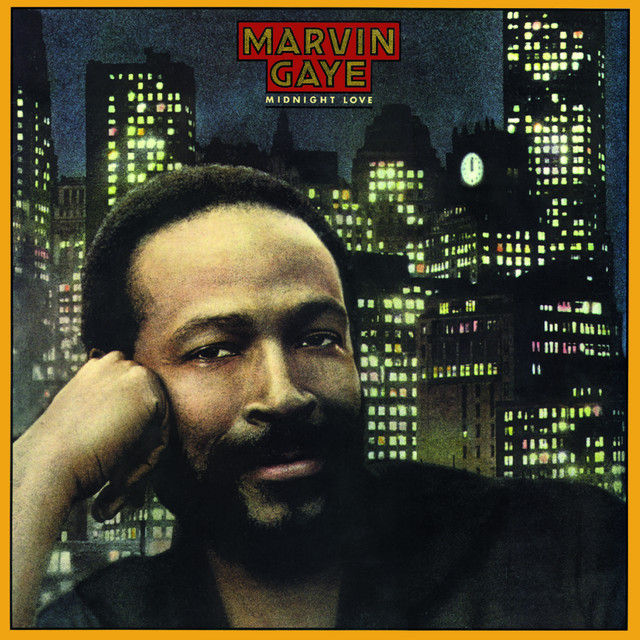
Marvin Gaye recorded "Sexual Healing" in 1982 for Midnight Love, his debut album for Columbia Records. The session was conducted in Belgium, where Gaye had relocated after years of personal and financial difficulties. The original arrangement came from a demo Gaye made with his collaborator Harvey Fuqua — and on that demo, the rhythm track was an 808. When the time came to record the album version, Gaye kept the 808 pattern: the closed hi-hat running at a steady sixteenth-note pulse, the open hi-hat landing on the two and four, the rim shot ghosting under the verse. It is a thin, dry, mechanical track under an extraordinarily warm vocal. The contrast is the production.
"Sexual Healing" reached #1 on the R&B chart in November 1982, staying for ten weeks. It reached #3 on the Billboard Hot 100. Gaye won two Grammy Awards for it in 1983. It remains one of the bestselling R&B singles of the decade.
The machine on which it was built was, at the moment of its Grammy wins, being discontinued by its manufacturer. The production cost of the 808 pattern on "Sexual Healing" was zero: the drum machine had already been purchased. The retail price of the LinnDrum that was supposed to replace it was $5,000. The 808 outlasted both.
3. Afrika Bambaataa and the birth of electro (1982)
If "Sexual Healing" proved the 808 could underpin a #1 soul record, "Planet Rock" by Afrika Bambaataa & the Soulsonic Force proved it could build a genre.
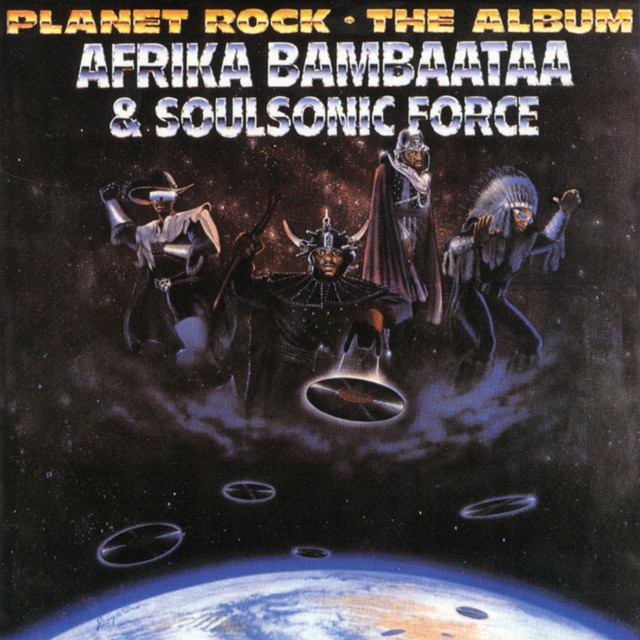
"Planet Rock" was produced by Arthur Baker and John Robie in 1982, released on Tommy Boy Records. Its construction method was assembling sampled melodic phrases from Kraftwerk's "Trans-Europe Express" and "Numbers" over an 808 rhythm track. The 808 cowbell — that weird, pitched-metal voice that Roland had included almost as an afterthought — runs through the entire record, giving it a percussive electricity that real percussion could not have produced. The 808's kick and hi-hat anchor everything underneath.
The Kraftwerk connection is often discussed as if Bambaataa simply borrowed their aesthetic. What he actually did was more radical: he took the German group's robotic, synth-driven sound — which Kraftwerk themselves had conceived as a critique of industrial modernity, not as party music — and recontextualised it through the Bronx club scene's commitment to keeping people dancing. The 808 was the hinge. The machine that Roland had marketed for home studios and hotel-lounge musicians became, in Baker and Robie's hands, the rhythmic engine of electro.
"Planet Rock" reached #4 on the UK Singles chart. In the United States it charted at #48 pop but #4 R&B. Its influence was disproportionate to its commercial peak: almost every record in the Miami bass, Detroit techno, and early hip-hop canons can be traced back to the sonic template Baker and Robie established with an 808, a synthesiser, and two Kraftwerk albums.
4. Run-DMC strips it down (1983–1984)
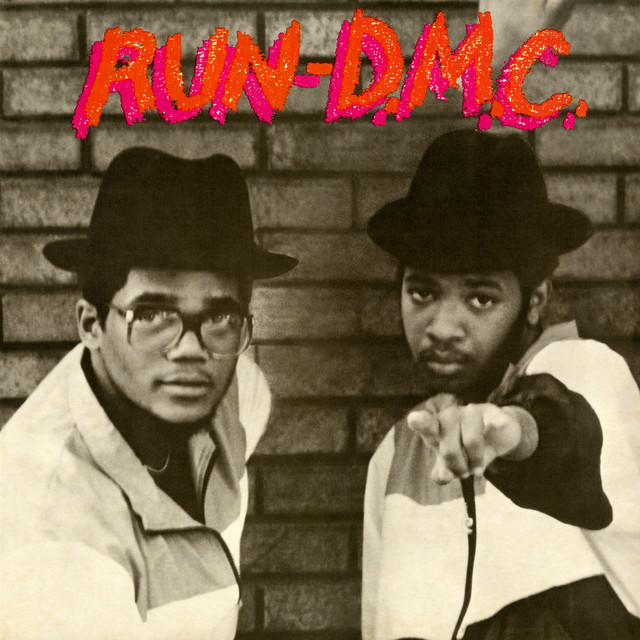
In 1983, two teenagers from Hollis, Queens — Joseph Simmons (DJ Run) and Darryl McDaniels (DMC) — recorded their first single in a New York studio with producer Larry Smith and manager Russell Simmons. The record was "It's Like That" backed with "Sucker M.C.'s (Krush-Groove 1)".
What Larry Smith did with the 808 on those records was almost perverse in its simplicity. No bass guitar, no keyboard melody, no samples. Just the 808 kick and snare, a tempo, and two rappers. The resulting sound was dry and confrontational in a way that no rap record had been before. The 808's synthesized kick — that low, decaying sine wave — pushed through the mix with a physical presence that real drum recordings of the period rarely achieved in the club. "Sucker MCs" sounded like furniture being moved.
This was the origin of what would later be called boom-bap: the drum machine-centred arrangement where the kick and snare did the structural work that in previous R&B and funk records had been distributed across a full rhythm section. The 808 made that possible because it was tuned correctly for the sonic constraints of vinyl: its frequencies sat below the midrange bustle of the arrangement and above the sub-bass noise floor in a way that translated cleanly from studio to speaker to headphone to club system.
The self-titled RUN-DMC album was released in 1984. It did not use a live drummer. Almost no major rap record released after it did either.
5. The Egyptian Lover and LA electro (1984)
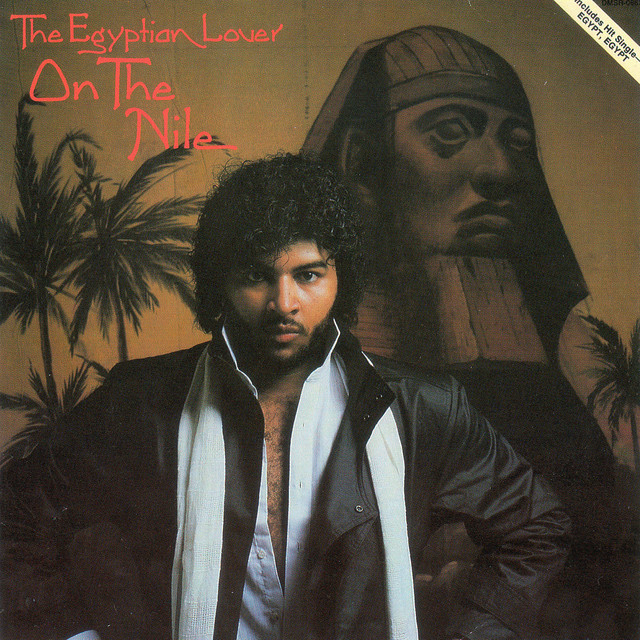
On the West Coast, the 808 was doing different work. The Egyptian Lover — Greg Broussard, a Los Angeles DJ and producer — was programming 808 patterns for the World Class Wreckin' Cru before launching his solo career. "Egypt, Egypt" (1984) runs at a slower tempo than the New York electro records, with an emphasis on the 808's low-end — particularly its bass drum, tuned down and allowed to decay into a sub-bass rumble that could rearrange a car stereo.
Broussard has described his relationship to the 808 in multiple interviews and in documentary footage as inseparable: he doesn't tour without his 808, doesn't write without it, considers it the central instrument of his practice. The title of the 2023 documentary about him is simply The Egyptian Lover and His 808. That relationship — one producer, one machine, a decades-long partnership — encapsulates what the 808 did for a generation of artists who could not afford session musicians: it was a rhythm section you owned outright and could program at 3am.
6. Mantronix and the dense layer (1985)
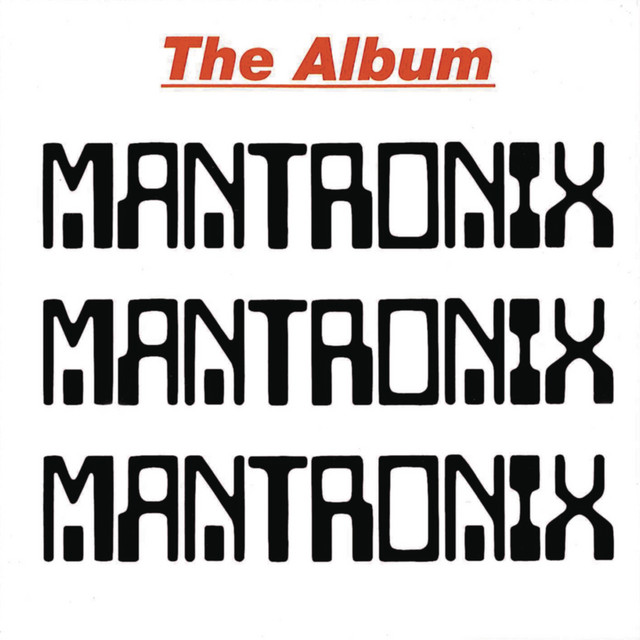
Kurtis Mantronik (Kurtis el Khaleel, born in Jamaica, raised in Canada and New York) built the Mantronix sound around layered 808 patterns at a time when most producers were using the machine as a single-layer rhythm track. "Bassline" (1985) stacks multiple 808 patterns running in polyrhythmic relationship — the kick on a different grid from the hi-hat, the clap offset from both — creating a density that anticipated trap music's approach to layered percussion by two decades.
Mantronix released The Album in 1985 on Sleeping Bag Records. Mantronik was 19. The 808 he used was, by that point, available used in New York pawn shops for considerably less than its original retail price. The machine's commercial failure had, quietly, begun to democratise it.
7. Whitney Houston and the cowbell (1987)
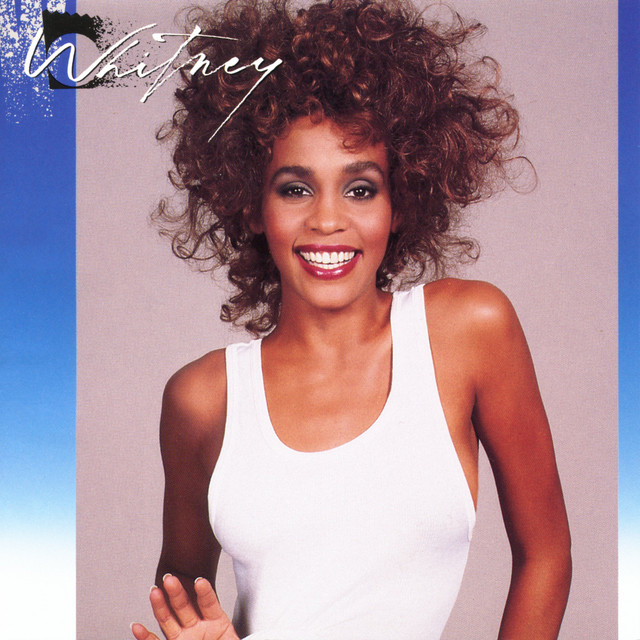
Here is a fact that most listeners have never noticed: "I Wanna Dance with Somebody (Who Loves Me)" by Whitney Houston — the biggest pop record of 1987, the lead single from Whitney, produced by Narada Michael Walden — contains a Roland TR-808 cowbell in the chorus.
It is not the dominant element. The production is busy: layered synths, live percussion, Whitney's vocal stacked in tripling harmonies. But the 808 cowbell is in there, cutting through the mix on every chorus beat, adding a metallic, mechanical quality that grounds the otherwise lush arrangement. Walden — a prominent session drummer and producer who had worked with Aretha Franklin, Starship, and Gladys Knight — understood that the 808's cowbell had a distinctive brightness that cut through dense mixes without occupying midrange real estate needed by other elements.
The song reached #1 in the United States, the United Kingdom, Australia, Canada, and eight other countries. The 808, which Roland had declared a commercial failure four years earlier, was present at one of the biggest pop records of the decade. It was hiding in plain sound.
8. Miami bass and the sub-bass tuning technique
The 808's kick drum has a pitch control. This is the detail that changed everything about how the machine was used once producers in Miami understood what it meant.
When you tune the 808's kick drum downward — reducing its fundamental frequency below the range where normal PA systems produce kick drums — the sound stops behaving like a percussive transient and starts behaving like a bass note. It retains its long decay, its sine-wave purity, its physical weight. But it also occupies a frequency range that, in a car with a subwoofer system, will rattle the trunk lid and the side mirrors. This is precisely what Miami bass producers wanted.
The 2 Live Crew — Luther Campbell (Luke Skyywalker), Christopher Wong Won (Fresh Kid Ice), David Hobbs (Mr. Mixx), and Mark Ross (Brother Marquis) — had formed in Miami by 1983 and were making records for Luke Records by the mid-1980s. "Me So Horny" (1989) from As Nasty As They Wanna Be uses the 808 bass-tuning technique as its foundational sonic element: the kick is tuned so low it functions as the bass line, leaving the midrange unoccupied for the vocal. The record was sued for obscenity in 1990 (the case reached the 11th Circuit) and sold two million copies.
The Miami bass producers — Magic Mike, DJ Laz, Maggotron, Splack Pack — refined the technique through the late 1980s and early 1990s into a genre that existed primarily as a car-audio technology. The goal was not to sound good in headphones or on home stereo; it was to produce the maximum physical effect on a Bose-equipped 1988 Honda Civic driving slowly through the parking lot of a South Florida shopping mall. The 808's pitch control made this possible. The subwoofer manufacturers owe it a royalty they have never paid.
9. Detroit techno and the electronic crossover
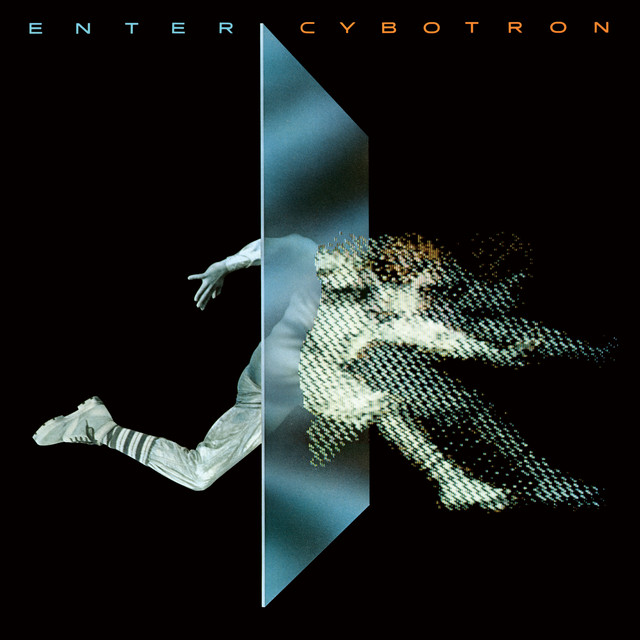
In 1983, Juan Atkins and Richard Davis released "Clear" as Cybotron on Deep Space Records in Detroit. The track — spare, mechanistic, driven by an 808 kick and a synthesised bass line — is one of the foundational documents of Detroit techno. Atkins had been listening to Bambaataa, to Kraftwerk, to P-Funk; the synthesis he arrived at placed the 808 in a context of science fiction and urban anxiety rather than party optimism.
Detroit's relationship with the 808 split as the decade progressed. By 1987–1988, when Derrick May and Kevin Saunderson were defining the second wave of Detroit techno, the Roland TR-909 — which had a more aggressive, punchy kick — became the preferred machine for the four-on-the-floor patterns that defined the genre. The 808 migrated into the electro and hip-hop streams. But the origin story runs through Detroit, and "Clear" remains one of the most precisely realised statements of what the 808 sounds like when it is not trying to sound like drums — when it is simply being itself.
10. The pawn-shop era and the boom-bap revolution
The 808's discontinued status was, paradoxically, the most important factor in its eventual dominance. Between 1983 and 1990, used TR-808s were available in pawn shops, secondhand music stores, and classified ads across American cities for between $50 and $200. The LinnDrum — the machine that was supposed to replace it — cost $5,000 new and was not being sold secondhand at anything close to 808 prices.
For producers working out of home studios in the South Bronx, Compton, Atlanta, Houston, and Miami, the calculation was straightforward: the 808 was the drum machine they could afford. The LinnDrum was for artists who had label deals and studio budgets. The 808's commercial failure had created a two-tier market in which the "better" machine was accessible only to established producers and the "failed" machine was in the hands of everyone else.
Those were the people who were about to redefine American popular music.
By the early 1990s, the 808 kick had become standard in hip-hop production not because it was cheap (it was no longer uniquely cheap — competing machines and software samples had proliferated) but because it sounded right for what hip-hop was doing. Its long sine-wave decay could be heard across a crowded venue in a way that a shorter, tighter drum-machine kick could not. Its tunable pitch meant it could be set to harmonise with the bass note of the track. Its synthesized quality, which had been the original objection, had become an identity: when listeners heard that decay, they knew what kind of music they were in.
11. The 808 as bass note — and the trap era's codification
The technique that Run-DMC and the Miami bass producers had discovered intuitively — tuning the 808 kick to function as a pitched bass element — was systematised by the Atlanta trap movement of the mid-2000s.
Producers Shawty Redd, Drumma Boy, and Lex Luger built the sonic signature of Atlanta trap around the 808 as the bass instrument. The standard arrangement: hi-hat rolls (often in 32nd-note triplets or sextuplets) over a slowly decaying 808 kick tuned to the key of the track. When Drumma Boy made "Standing Ovation" for Young Jeezy (on Thug Motivation 101, 2005), the 808 kick was doing double duty as both the drum pattern's foundational hit and the bass line. The track had no separate bass guitar or synthesised bass — the 808 was all of it.
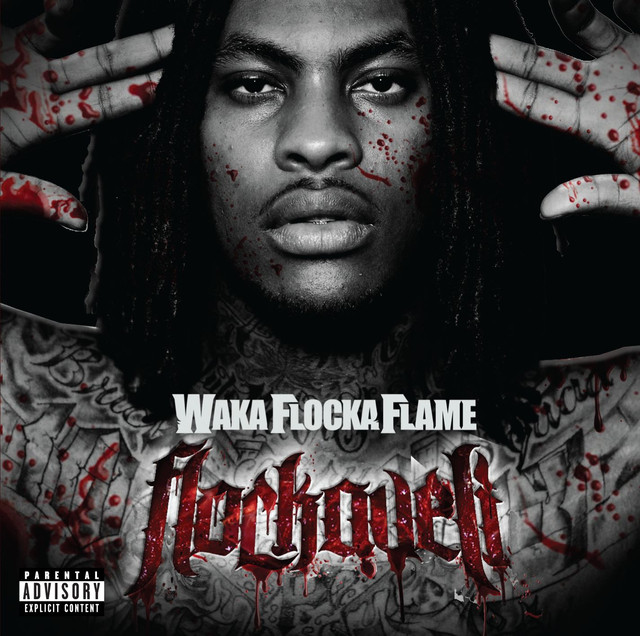
By 2010, Lex Luger's production for "Hard in da Paint" by Waka Flocka Flame had compressed the trap template into its most extreme form: the 808 kick tuned down to a frequency that physically pressurised the room, the hi-hats running at machine-gun speed, the arrangement so stripped of additional elements that Waka Flocka's voice was performing against what was essentially a percussion-and-sub-bass wall. The track does not have a melody. It barely has a chord. It has an 808 and a voice, just as Run-DMC had twenty-seven years earlier — but with the bass turned up to the point where it became a physical experience.
Metro Boomin, who would become the dominant production voice of the 2010s trap era (Future, 21 Savage, Young Thug, Drake), built his entire aesthetic around the 808 as bass/kick. "Tony Montana" by Future (originally a 2011 mixtape track, later appearing on Pluto in 2012) uses the Metro-adjacent template: a sparse, reverb-heavy keyboard figure over an 808 pattern in which the kick decay lasts almost an entire bar, overlapping with the next kick's onset and creating a continuous sub-bass smear rather than a discrete rhythmic hit.
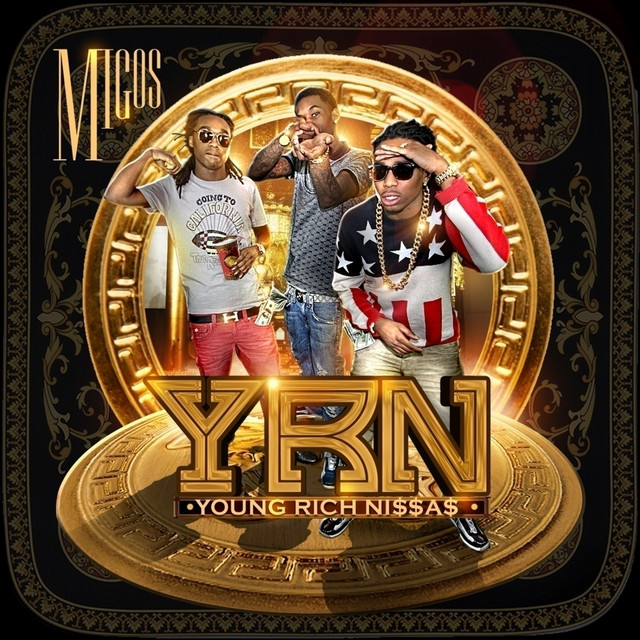
Migos and producer Zaytoven brought the 808's hi-hat potential to its fullest expression: "Versace" (2013) uses 808-derived hi-hat patterns in triplet subdivisions — the "triplet flow" that the Migos are credited with popularising — to create a rhythmic density entirely distinct from the simple sixteenth-note patterns of earlier trap. The 808 had been used as a kick-as-bass for thirty years; Migos and their contemporaries demonstrated that the machine's entire sonic vocabulary — hi-hat, clap, kick — could be restructured around a new rhythmic grammar.
12. Kanye West names the album (2008)
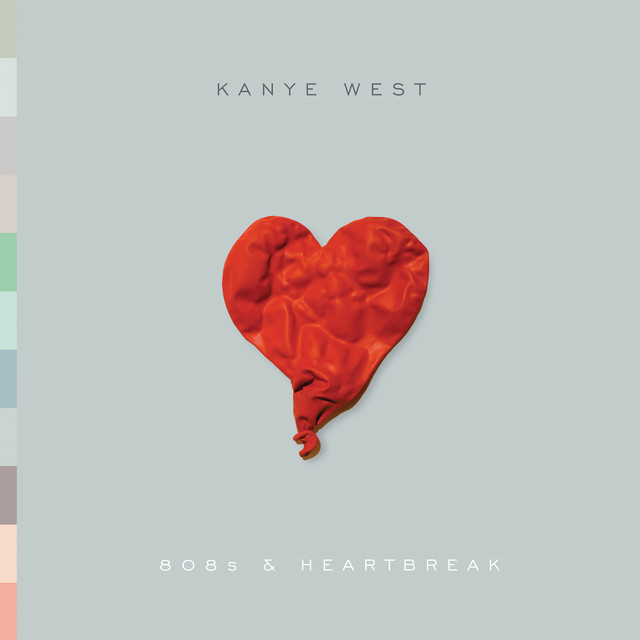
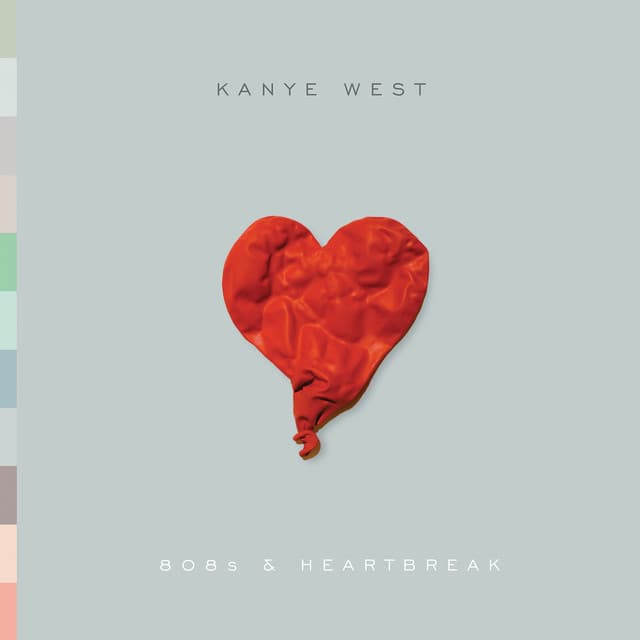
In November 2008, Kanye West released 808s & Heartbreak. The album was made in three weeks following the death of his mother, Donda West, and the breakup of his engagement. It was named after the drum machine. Every track is built around 808 kicks and, to varying degrees, Auto-Tune processed vocals.
"Heartless" runs at 80 BPM — slow enough that each 808 kick decay has time to fully develop before the next kick arrives, making the relationship between the kick's frequency and its duration maximally apparent. "Love Lockdown" uses the 808 kick almost as a taiko drum, with long spaces between hits and a decay that functions as the track's sustained emotional register rather than its rhythmic pulse.
The album was commercially successful (four US million copies eventually) and critically divisive at release. Its long-term consequence was to establish the 808's aesthetic — the long kick, the distorted sub-bass presence, the use of drum machine patterns at tempos too slow for dancing — as the dominant framework for what popular music's emotional registers sounded like. The Auto-Tune vocal and the 808 kick share a structural characteristic: both take a human expression (voice, drumming) and process it through an electronic transformation that makes it simultaneously less realistic and more resonant in specific sonic contexts. 808s & Heartbreak was the first album to make that parallelism explicit in its title and to build an entire artistic statement around it.
Drake's subsequent output — the introspective, 808-heavy, Auto-Tune-inflected records from Take Care onward — is the most commercially successful extension of the 808s & Heartbreak template. Drake has acknowledged Kanye's album as a direct influence on his approach to vocal production and emotional register. The chain runs: 808 kick as emotional vehicle → 808s & Heartbreak → Drake → the dominant aesthetic of streaming-era R&B and hip-hop.
13. "Around the World," Daft Punk, and the pop transfer
The 808's migration into electronic dance music followed a different trajectory from its hip-hop adoption. Daft Punk's "Around the World" (1997, from Homework) uses the 808's hi-hat and clap in a minimalist house arrangement that runs for exactly as long as it takes to establish and exhaust its hypnotic potential: seven minutes. The track has four musical elements — a bass line, a chord stab, a vocal phrase, and a drum pattern — and the 808 provides three of the four drum voices.
Daft Punk's approach to the 808 was archaeological as much as practical. By 1997, software drum machines and sample libraries could provide cleaner, more controllable percussion than any hardware unit. Thomas Bangalter and Guy-Manuel de Homem-Christo chose to use the 808 (and the TR-909 for different material) because those machines had a sonic signature — a warmth, a specific compression character, a particular relationship between transient and decay — that digital emulation was not yet replicating convincingly.
"Around the World" sold millions of copies across Europe and reached the Top 10 in twelve countries. In the United States it reached #61 on the Hot 100 — a commercial underperformance relative to its later reputation, but evidence that the 808's sonic vocabulary had become recognisable as a marker of sophistication in European electronic music before it had completed its second American revolution.
14. Travis Scott and the 808 in 2018
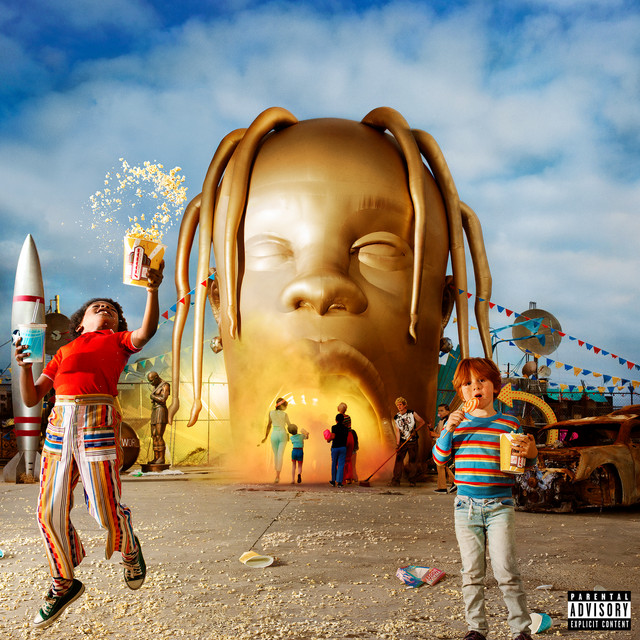
"SICKO MODE" — Travis Scott featuring Drake, produced by Tay Keith, Oz, Frank Dukes, and others — is three separate beats in one track. It begins with a swimming-pool-reverb piano chord that is essentially a Marvin Gaye homage. It transitions into a Metro Boomin-adjacent trap arrangement. Then it shifts again. In all three sections, the 808 kick anchors the low end, tuned to sit in the frequency range that festival subwoofer arrays are designed to reproduce.
The track was streamed 2.5 billion times in its first two years. Its production credit list — seven producers on a major-label hip-hop record — reflects the degree to which 808-centred production had become a collaborative, distributed craft rather than a solo practice. The 808 is not one producer's instrument anymore; it is the genre's shared foundational syntax. Every producer on "SICKO MODE" knows what the 808 kick is supposed to do and at what frequency and with what decay time, the way that every jazz rhythm section player knows what the ride cymbal is supposed to do in a medium-tempo standard.
15. The cultural object and the reversal
The 808 documentary — 808 (2015), directed by Alexander Dunn and narrated by Pharrell Williams — interviewed over forty producers, artists, and musicians about the machine. Among them: Questlove, Lil Jon, Afrika Bambaataa, Juan Atkins, Dave Grohl, and Marvin Gaye's son Bubby Gaye. The documentary's thesis — that one drum machine had underpinned more commercial music than any other single piece of equipment in history — did not require much argument by 2015. The evidence was in the credits of almost every major American pop and hip-hop record since 1982.
In the same year, Roland released the TR-08 as part of its Boutique series: a miniaturised, circuit-board-accurate recreation of the original TR-808, retailing at approximately $350. Vintage original TR-808 units were by then selling at auction for between $5,000 and $10,000 — five to ten times their original retail price. The machine that Roland had discontinued as a failure was returning a $4,000 to $9,000 premium over its 1980 list price to anyone who had bought one used for $100 in 1985 and held it.
This is not an unusual story in the history of musical instruments. The Fender Telecaster was considered a crude, cheap guitar when introduced in 1950. The Hammond B-3 organ was discontinued in 1975. The Moog synthesiser was considered an expensive novelty. What is unusual about the 808 is the specificity of its influence: it is not simply a beloved instrument with a cult following. It is the rhythmic foundation of the dominant commercial music of its era.
16. Why the synthesized kick won
The 808's kick drum beat real drum recordings in hip-hop and trap production for a structural reason that has nothing to do with authenticity and everything to do with physics.
A real kick drum, recorded in a studio, has a complex envelope: a sharp transient attack, a quick decay through multiple frequency bands, a short sustain, and a release that follows the natural acoustic characteristics of the drum shell and head. In a dense mix — with bass guitar, keyboards, samples, and a vocal — this transient gets buried. Engineers spend significant time and equipment trying to make the kick audible in a crowded frequency spectrum.
The 808's kick is a sine wave: a single frequency with a long, exponentially decaying tail. It does not compete with midrange frequencies because it does not occupy them. It does not require compression to sit in the mix because its attack is already shaped by the analog circuitry. When you tune it to the key of the track, it harmonises with the bass — or replaces it entirely — without creating the muddiness that a real bass guitar and real kick drum would produce if both were running at high volume simultaneously.
The 808 did not win because producers loved the sound of synthesized drums. It won because it solved a mixing problem that real drums made harder. The long sine-wave decay that engineers in 1980 called "fake-sounding" is, from the perspective of frequency physics, an extremely efficient way to produce sub-bass energy in a recording.
Tadao Kikumoto's team at Roland built a machine that was trying to simulate real drums and failed. In failing, they invented a more useful tool than the one they were aiming for.
Sources
- Roland TR-808 Rhythm Composer product history — www.rolandus.com/blog/the-story-of-the-tr-808
- "808" documentary (2015), directed by Alexander Dunn — distributed by Studio Canal
- Wikipedia — Roland TR-808 — https://en.wikipedia.org/wiki/Roland_TR-808
- Wikipedia — Tadao Kikumoto — https://en.wikipedia.org/wiki/Tadao_Kikumoto
- Wikipedia — Sexual Healing — https://en.wikipedia.org/wiki/Sexual_Healing
- Wikipedia — Planet Rock (song) — https://en.wikipedia.org/wiki/Planet_Rock_(song)
- Wikipedia — Afrika Bambaataa — https://en.wikipedia.org/wiki/Afrika_Bambaataa
- Wikipedia — Cybotron (band) — https://en.wikipedia.org/wiki/Cybotron_(band)
- Wikipedia — Juan Atkins — https://en.wikipedia.org/wiki/Juan_Atkins
- Wikipedia — Trap music — https://en.wikipedia.org/wiki/Trap_music
- Wikipedia — Miami bass — https://en.wikipedia.org/wiki/Miami_bass
- Wikipedia — 808s & Heartbreak — https://en.wikipedia.org/wiki/808s_%26_Heartbreak
- Wikipedia — Mantronix — https://en.wikipedia.org/wiki/Mantronix
- Wikipedia — Egyptian Lover — https://en.wikipedia.org/wiki/Egyptian_Lover
- Wikipedia — 2 Live Crew — https://en.wikipedia.org/wiki/2_Live_Crew
- Red Bull Music Academy lectures — "The 808 Across Genres" — https://www.redbullmusicacademy.com/lectures/808-across-genres
- FACT Magazine — "How the Roland TR-808 took over the world" — https://www.factmag.com/2013/09/30/how-the-roland-tr-808-took-over-the-world
- Pitchfork — "808s & Heartbreak" review (re-appraisal) — https://pitchfork.com/reviews/albums/13000-808s-heartbreak
- The Wire — "Cybotron and the Detroit Sound" — https://www.thewire.co.uk/in-writing/essays/the-wire-200_cybotron
- NPR Music — "The Drum Machine That Changed Music" — https://www.npr.org/sections/therecord/2012/09/21/161476709
- Mixmag — "Planet Rock: the night that changed music" — https://mixmag.net/feature/planet-rock-how-this-one-night-changed-music-forever
- The Ringer — "The 808 and the history of American pop" — https://www.theringer.com/music/2019/808-roland-drum-machine-history
- DJHistory.com — Afrika Bambaataa interview — https://www.djhistory.com/interviews/afrika-bambaataa