Going Totally Bananas: why Hollaback Girl is a banana song, and why older playlist tools miss it
Playgen dropped Gwen Stefani's Hollaback Girl into a playlist about bananas. At first it looks broken. It isn't — and the reason is the whole thesis behind running the latest LLMs for playlist generation.
By Gabin Fay
We asked Playgen for a playlist about bananas. You can see it here:
→ Going Totally Bananas on Spotify
Twenty tracks. Calypso, Harry Belafonte's Banana Boat (Day-O) at the top. Bananaphone by Raffi. Banana Pancakes by Jack Johnson. 30,000 Pounds Of Bananas by Harry Chapin. Obvious wins.
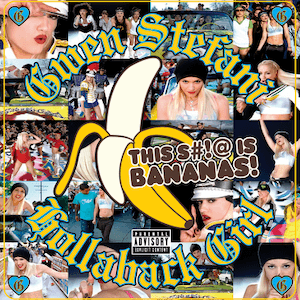
Then, at slot two, Gwen Stefani — Hollaback Girl.
Your first instinct is reasonable: the app is broken. Hollaback Girl is a 2004 pop-rap single about a girl refusing to be called out. It has a cheerleader-chant hook. It is about aggression, not fruit. How did it end up on a playlist about bananas?
You hit play anyway. At 1:06 Gwen says:
"This shit is bananas. B-A-N-A-N-A-S."
Then she says it again. And again. The word "bananas" appears in the chorus sixteen times across the song. The official music video has a line of cheerleaders holding up letters that literally spell B-A-N-A-N-A-S across the frame, which is the defining visual of the track — it's the first thing you see when you Google the song.
It is, by a mile, the most culturally dominant song about the word "bananas" in the last twenty years. The playlist isn't broken. The playlist is right in a way that a dumber system could never be.
Why older playlist tools can't do this
Think about how the previous generation of playlist tools would handle the same prompt.
A keyword search on Spotify for "bananas" returns tracks with "banana" in the title. It never reaches Hollaback Girl, because the title is Hollaback Girl. The word "bananas" doesn't appear in metadata you'd search on — not the artist, not the album, not the official Spotify tags.
A taste-based recommender like Spotify's own mix doesn't help either — it recommends from your listening history, not from a concept. You cannot type "bananas" into Daily Mix.
Earlier AI playlist tools used smaller, older models. They know that Banana Boat is about bananas because the title says so. They do not know that Hollaback Girl is about bananas, because that requires three things simultaneously:
- Lyrics knowledge. The model has to recall the chorus — and know that "B-A-N-A-N-A-S" is the song's single most iconic line.
- Cultural context. It has to know the music video spells out bananas in a cheerleader formation, and that this video is burned into internet memory.
- Reasoning. It has to decide the thematic weight of the word inside the song is strong enough that the track belongs on a bananas playlist, not just a "songs that mention fruit" list.
This is a meaningful jump. Most older models would return track titles that contain the literal word. Only a modern model does the connection.
Why Playgen keeps getting smarter
Playgen runs on the latest generation of large language models available. We roll to the newest model the moment it ships. This matters for two reasons.
First: the training data is fresh. A model trained in 2022 doesn't know about records released in 2025. A 2026-era model does. If you ask for "the sound of late 2025 indie sleaze," only a current model has a chance of naming the right tracks.
Second: the reasoning is better. Newer models don't just have more data — they're better at connecting the prompt to non-obvious songs. Hollaback Girl is exactly that kind of connection. The track title doesn't scream "bananas." The cultural reality does. Only a model capable of holding both the lyrics and the video context at once makes the call.
Older tools are stuck. They were built around a specific model, a specific prompt chain, a specific API shape. Swapping the brain for a new one is a rewrite. So they don't. The output stops improving.
Simple enough to never break
The other reason we keep winning here is architectural, and it's boring on purpose.
Playgen has almost no moving parts. Prompt in → LLM returns track list → Spotify search matches each track → public playlist gets created → you click the link. That's it. There is no taste profile to train, no "personalization layer" to drift, no refine loop, no mood classifier, no collaborative filter, no engagement metric to optimize against.
This is deliberate. Complexity is what rots playlist tools over time — the personalization gets stale, the moods misclassify, the vibe weights get retuned by whoever owns the roadmap that quarter, and three years in the tool only sort-of works. Playgen has one product: you describe a scene, we hand you a Spotify link. That's narrow enough that when a better LLM ships, we swap it in and the product gets sharper without getting more fragile.
A simple tool with the best available model beats a complicated tool with a stale one. Every time.
The takeaway
If the word "Hollaback Girl" on a bananas playlist made you roll your eyes, you weren't wrong to check. You were exactly the user we want — you dug in, found the B-A-N-A-N-A-S chorus, and now you know the playlist is doing real semantic work, not keyword matching.
The reason this works is that Playgen sits on top of whatever the current best model is, not on top of a frozen snapshot of one from three years ago. And the pipeline is dumb enough around the model that we can keep doing this indefinitely.
→ Listen to Going Totally Bananas
Or write your own weird, specific prompt and see what comes back.